
Ara Radvilė
The Shape of Wholeness

We first discovered Ara through our magazine, CAP 74024, and immediately felt the desire to know her better. Then, in February, while I was in Lithuania for other projects, I had the chance to meet her in Užupis*, Vilnius.
*Užupis is a small artistic district often described as the “Republic of Užupis” - a self-declared independent neighbourhood filled with galleries, poetry, studios, and a deeply creative spirit. It feels like a dream any artist would want to step into.
What struck me immediately was not only the strength of Ara’s work, but her presence as a person. There is something incredibly beautiful about her, both inside and out, and you can feel it not only through her paintings, but also through the self-portraits and images she creates. You immediately understand that photography and scenography are part of her language, every detail feels instinctive, cinematically carefully composed.
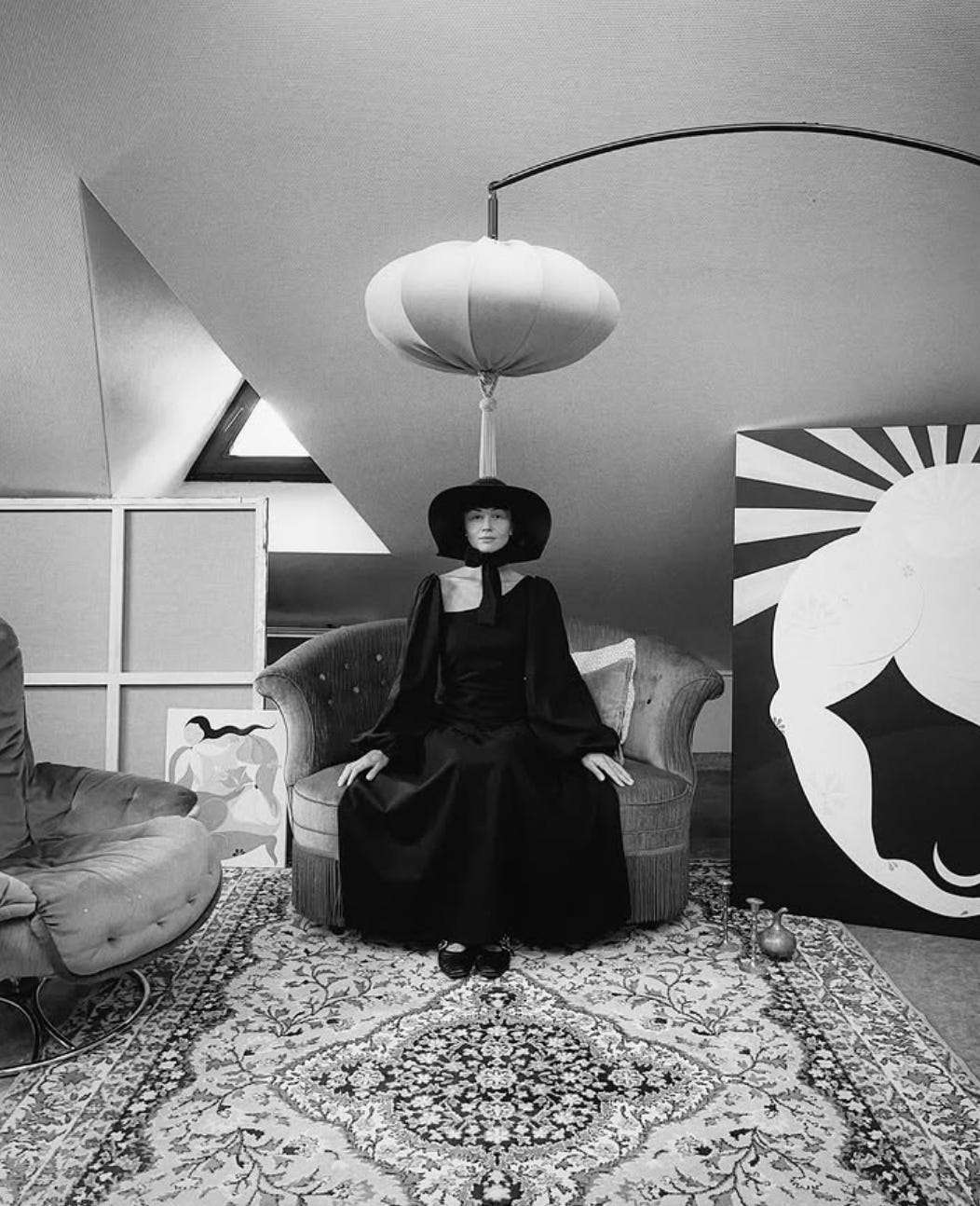
More than anything, I wanted the world to meet this beautiful soul.
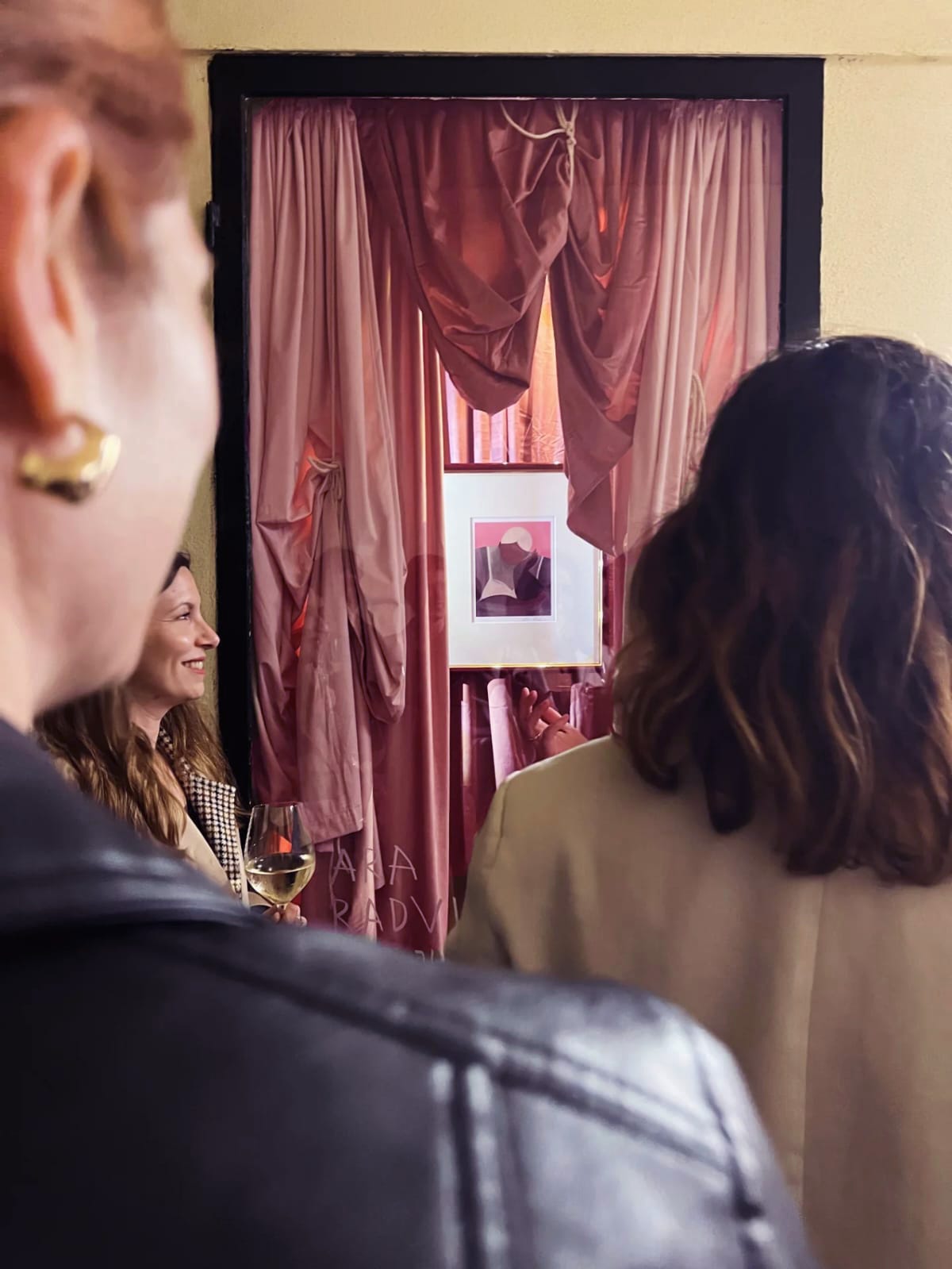
It was snowing heavily that day, almost –15 degrees, when Ara welcomed me into her beautiful studio, behind the pink door (!!!), the space where she paints and hosts workshops. Hidden in the middle of winter, it felt like a magical little corner dedicated entirely to art and sensitivity.
Because of the flight disruptions happening at the time, we couldn’t organise the planned shooting in Vilnius for the magazine. So instead, I invited her to showcase her artwork at Abadat Gallery.
And here we are.
I’m incredibly proud to present this extraordinary woman and her universe.
You’ve described art as something that came from necessity rather than ambition, when did you first realise you needed it?
Creativity entered my life in early childhood. Back then, it wasn’t ambition, but necessity, a way to survive. Immersing myself in the creative process and reaching a state of complete concentration helped me, as a very restless child, to simply exist.
I had an incredibly vivid imagination: I would construct complex scenarios and characters in my head, and in my mind, even inanimate objects could come alive. Later, all of this naturally found form through photography, poetry and painting.
Your work transforms inner chaos into calm, does painting still feel like that for you today?
Today, that transformation no longer feels as drastic, simply because there is far less chaos in my life. But the sensitivity remains, as does the ability to transform difficult experiences into gentleness.
For me, painting is ultimately about deep calmness and a sense of totality. Even that former chaos now feels like an inseparable part of wholeness.
Your circular forms feel like symbols of safety and completeness, are they intuitive, or something you consciously return to?
The circular forms appear completely intuitively, they come from the gut.
The belly is the central figure throughout my entire creative practice. Years ago, I experienced a traditional abdominal massage rooted in the traditions of the Shipibo tribe in Peru, and it awakened something very clear within me. Since then, it has become the true axis of my painting.
From it, the circle is constantly born, the same form from which the universe and celestial bodies themselves are created.
Your background spans scenography, photography, and painting , how do these worlds meet in your work now?
Photography entered my life very early. Through the lens, I began observing both the world around me and myself. It became a way of constructing reality within a small frame, translating the fantastic inner world of my childhood into something tangible.
I am a scenographer by profession, and that experience deeply informs my painting. When I stand before a canvas, I already understand the space of the piece and its depth.
That’s why, when preparing exhibitions, I struggle to imagine my work inside a simple white cube. It is important to me that the paintings become part of a complete environment, where objects, light, sound and even scent intertwine.
Your figures feel both monumental and soft, how do you think about that balance between strength and vulnerability?
The bodies in my work are made of clear, large, often flat forms. Yet behind those surfaces, invisible codes seem to be inscribed - sensitivity, openness, things I sometimes cannot even express through words.
Perhaps they are only truly perceived by the observer for whom, without even knowing it myself, I am painting.
You told me, “These are not women that I paint.” So what are those figures?
For a long time, I painted the female body. But now, the figures feel massive and genderless, as though they belong to distant, vanished civilizations.
This is no longer a story about gender, but about duality and a fundamental sense of wholeness.

Do you have a specific process of creation?
Routine is very important to me, but at the same time I am constantly searching for symbols within everyday life.
I document a lot: daily events, conversations, sketches. Before I begin painting, I always read poetry and pull a Tarot card, not to predict the future, but to establish the emotional direction of the day.
What’s your favourite piece you’ve made so far?
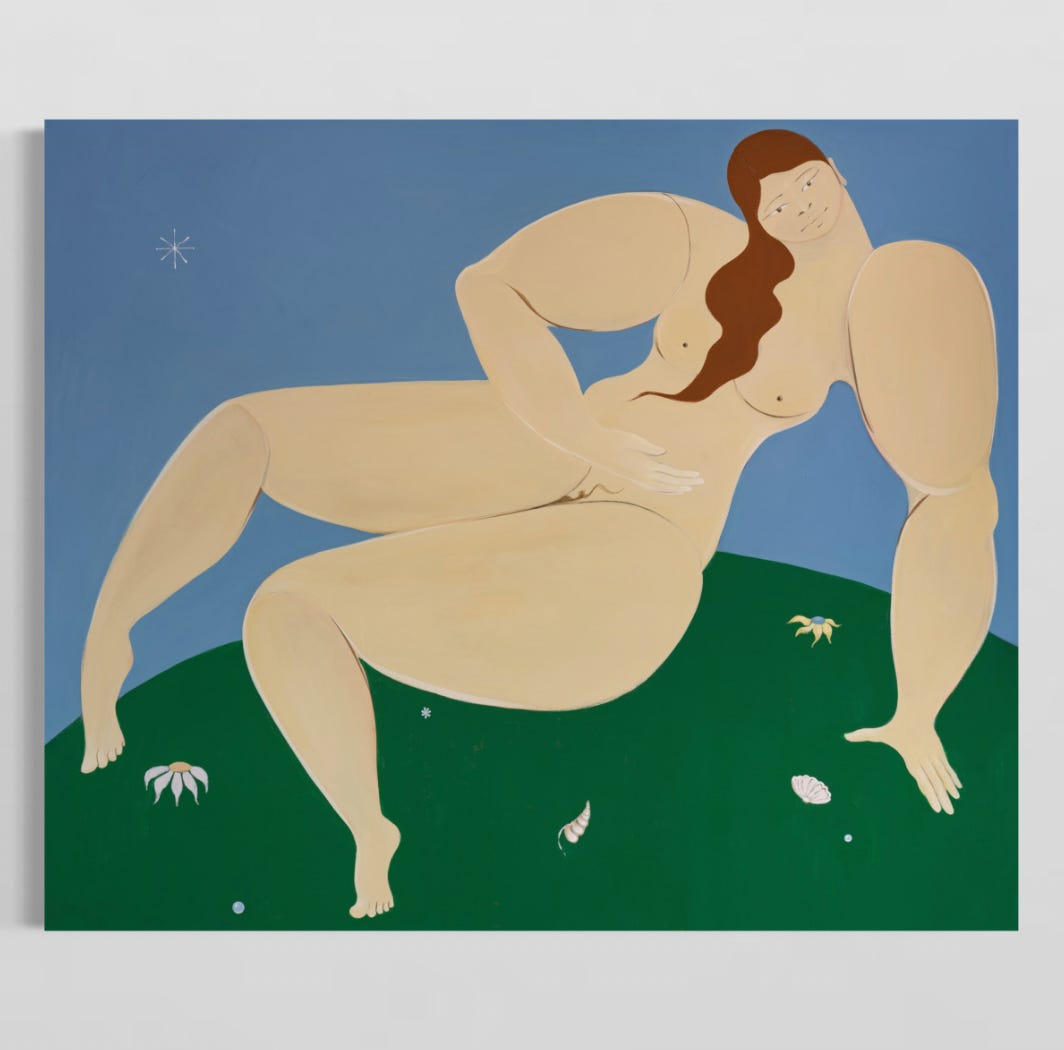
A painting titled Playground. It is the only work of mine hanging in my own home.
It is deeply important to me because it contains someone very dear to me. The piece also marks a personal transformation and a profound creative realization.
What catches your attention in everyday life?
Silence.
And the number two.
Is there a fleeting detail or moment you find yourself returning to?
I am guided by whatever seems to “need” my attention in a given moment: recurring events, a button snapping off several times a day, fragments of strangers’ conversations or numbers that seem to follow me.
What’s your favourite biscuit?
“Grybukas” - a small sponge biscuit shaped like a mushroom, with a chocolate cap and a white glazed stem. My grandmother used to bake them.
What do you know now that you wish you’d known earlier?
I don’t think I would want to know anything in advance. Everything arrives at the right moment, when you are ready to receive it.
Perhaps there is only one thing I would remind myself more often: that everything is unfolding exactly as it is meant to.
How is life in Užupis?
Life in Užupis is wonderful.
With the arrival of spring, everything becomes even more alive: the river and the sunlight draw poets outside with glasses of wine in their hands, while the bells of the shamanic shops ring louder through the air.
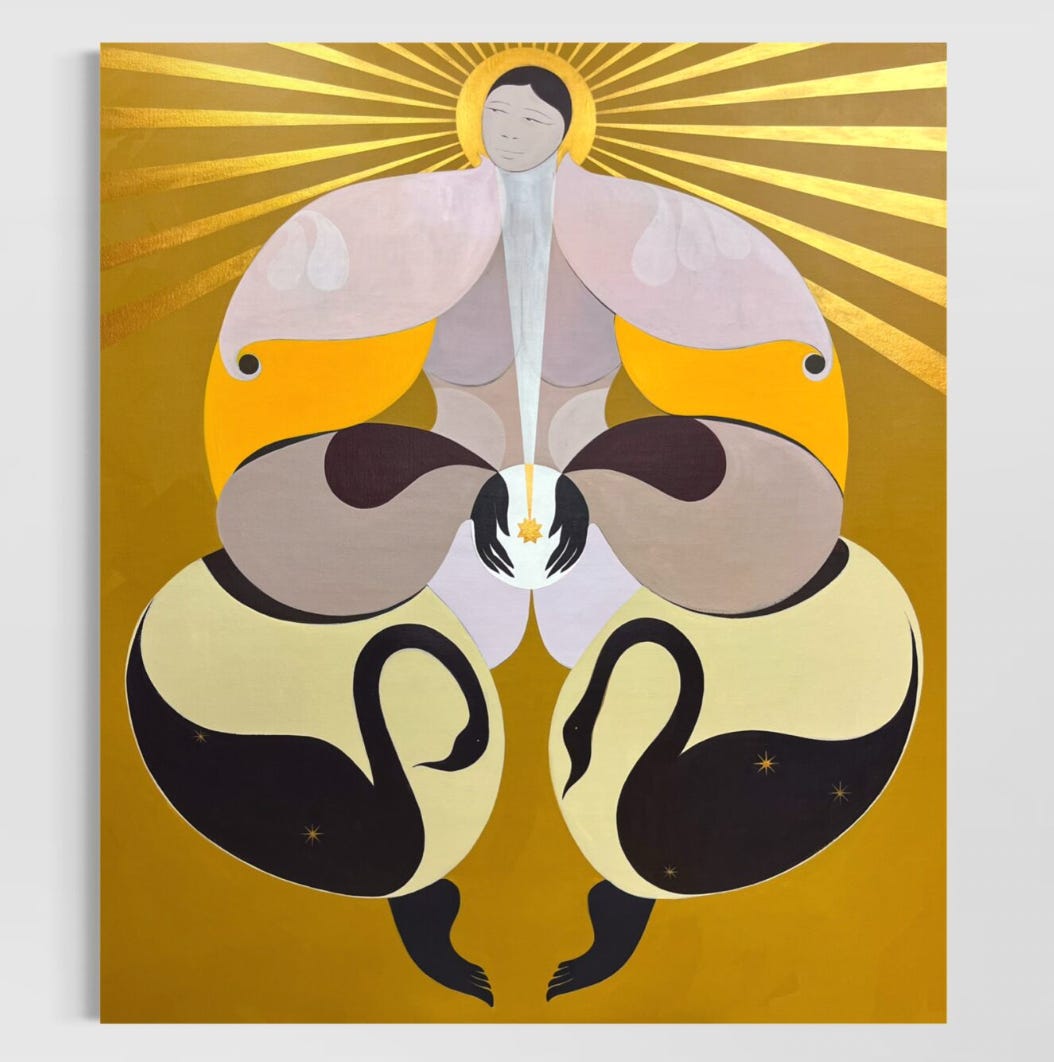
I’ve noticed swans appear often in your work, and I’m very curious about them because I’m personally obsessed with swans and always feel deeply drawn to artists who represent them. What do swans mean to you, and why do you find yourself returning to them?
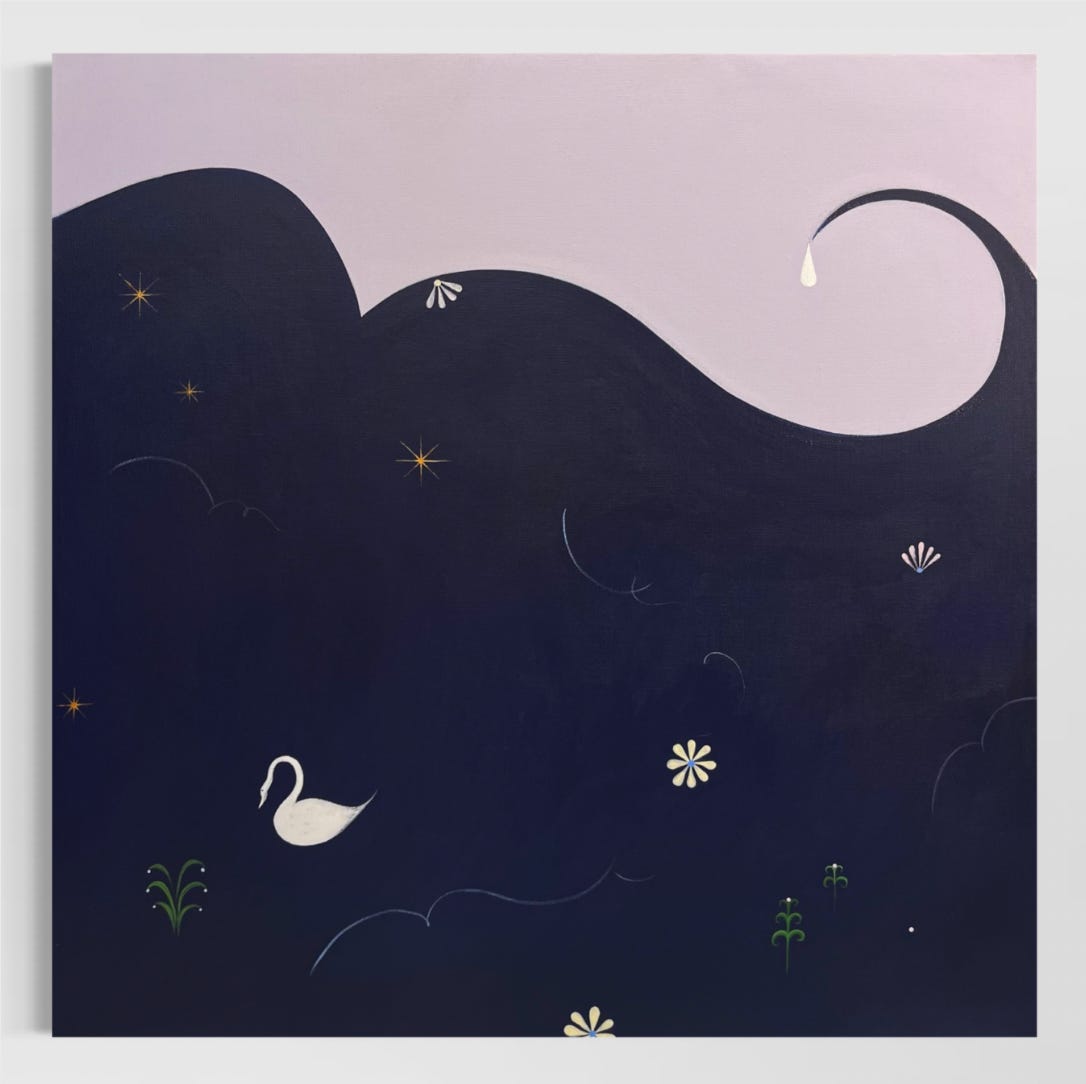
The swan in my universe is a kind of conductor between the earth and the sky. This connection started back in my teenage years when I used to spend hours watching them at the pond and writing short poems. For me, this majestic bird is a being “from elsewhere”. I often depict a swan swimming through the stars or covered in feathers made of celestial bodies. Furthermore, as I mentioned, I am constantly looking for the number “2” in my surroundings and my art—it is my symbol of harmony. The shape of a “2” naturally transforms into the silhouette of a swan, so they appear very organically on my canvases.
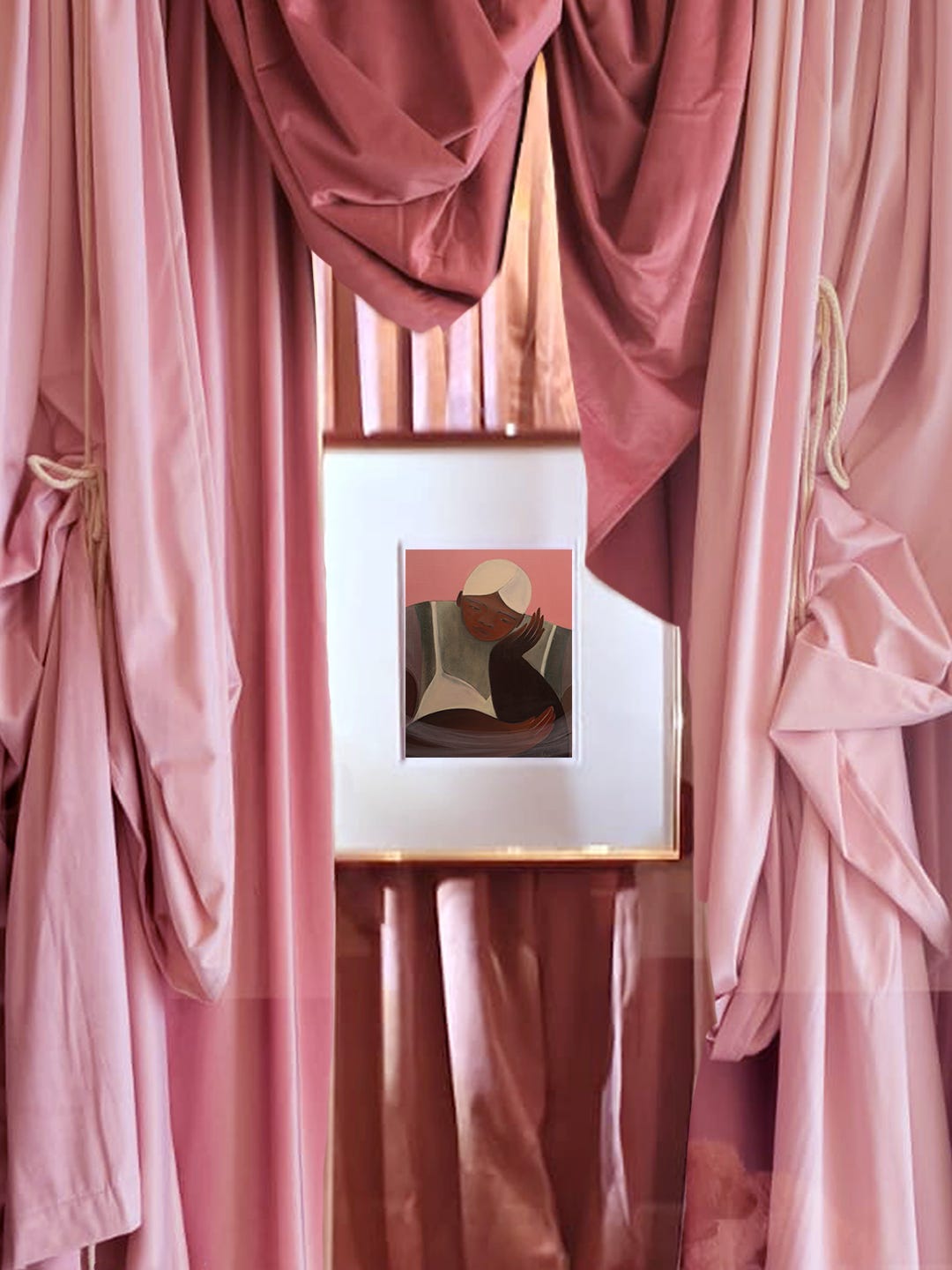
I’m now a proud owner of your artwork “Warm Milk”, I love it so much, and I feel like I can stare at it for hours. Tell me about it.
The piece "Warm Milk" is a very sensitive work about waiting, coming from my series "Stone, Milk, Heart". In this collection, I portrayed the body as a mountain, something solid and eternal, like stone. However, "Warm Milk" represents the moment when that hardness begins to soften. For me, milk is a life-giving flow coming from the subconscious or other realms to warm and nourish us from within. It’s a story of how a heavy, monumental body becomes a gentle vessel for feeling and care.
If someone could feel one thing when they experience your work, what would you want it to be?
Wholeness.
That quiet feeling that everything is finally in its right place.
Ara’s artwork “Warm Milk” is showcasing at Abadat gallery from 15. 05. - 15. 06. 2026. (if you are interested you can buy the print here)